
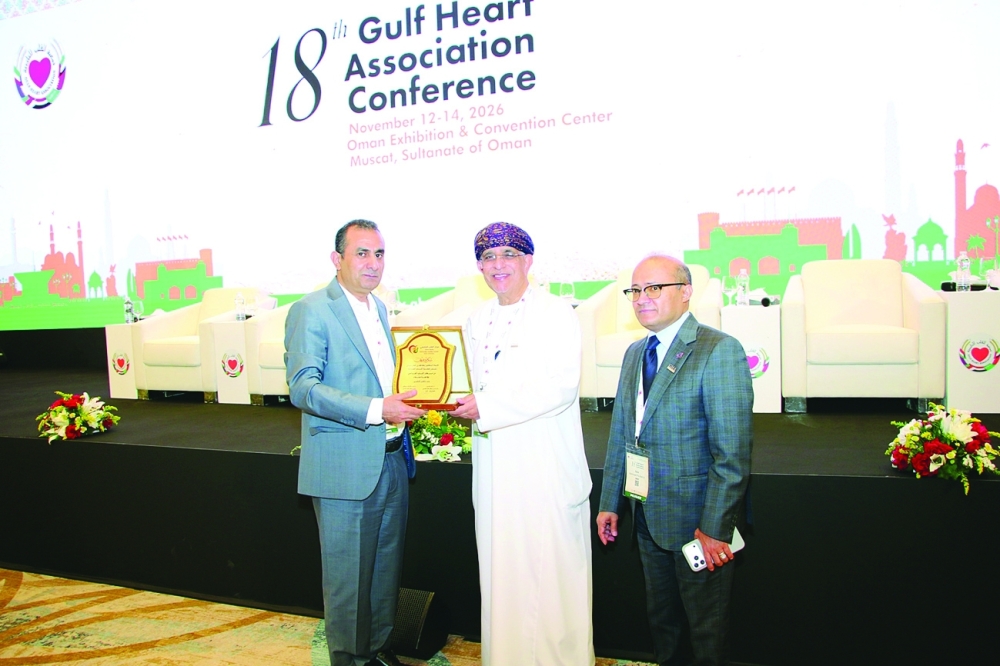


Muscat, Nov 14
Heart disease is on the rise in the Gulf region while declining in Europe and the West, doctors warned, calling for a focus on prevention efforts at the conclusion of the 18th Gulf Heart Association Conference in Muscat on Saturday.
Dr Kadhim Jaffer Sulaiman, Chairman of Oman Heart Association (OHA), said that the decrease in deaths despite the rise in cases reflects the high level of treatment, but reveals a relative weakness in prevention. He pointed out that about 65 per cent of the population of the Sultanate of Oman is overweight.
Regarding treatment, data presented by Dr Fahad al Kindi, Senior Consultant Cardiologist at Sultan Qaboos University Hospital, showed that the time needed for opening a blocked artery in stroke patients at the hospital decreased to about 75 minutes in 2024, compared to 142 minutes in 2018 and 2019. The number of cardiac catheterisation centres increased to seven after the opening of centres in Suhar, Nizwa, and Sur.
Al Kini believes the next challenge is building a unified national network linking ambulances to hospitals and catheterisation centres, advising anyone experiencing stroke symptoms to call an ambulance immediately, rather than driving themselves to the hospital.
Dr Khalid al Saidi disclosed plans to establish the first artificial intelligence-based cardiac registry in the Sultanate of Oman.
The two-day conference was attended by approximately 700 doctors and specialists.
Al Saidi presented a working paper in which he highlighted a number of challenges and gaps in the application of evidence-based treatments, particularly with respect to improving the use of lipid-lowering, anticoagulant, and antiplatelet therapies in patients who have suffered heart attacks or undergone coronary interventional catheterisation.
The working paper discussed a research initiative planned for the National Heart Centre at the Royal Hospital. The initiative involves a preliminary study to demonstrate the feasibility of employing artificial intelligence (AI) agents in analysing real-world medical data. The objective is to identify treatment gaps and opportunities to improve patient care following heart attacks and coronary interventions.
The initiative is expected to create the first AI-based cardiac registry in the Sultanate of Oman, from its initial design and implementation phases. This represents an innovative approach to scientific research and the development of quality healthcare services. By transforming available medical data into clinically valuable indicators and information, the initiative is expected to contribute to identifying unmet needs, promoting evidence-based medical practices, and supporting efforts to improve patient outcomes.
He stressed the importance of employing AI agents to extract and analyse data from electronic medical records, identify shortcomings in clinical practices, and provide actionable analytical indicators and information to support medical decision-making and improve the quality of patient care.
Oman Observer is now on the WhatsApp channel. Click here